Why the Shape of a Playing Field Changes the View
Why the shape of a playing field changes the view: learn how boundaries, slopes, and landmarks shape play, sightlines, and a place’s character.
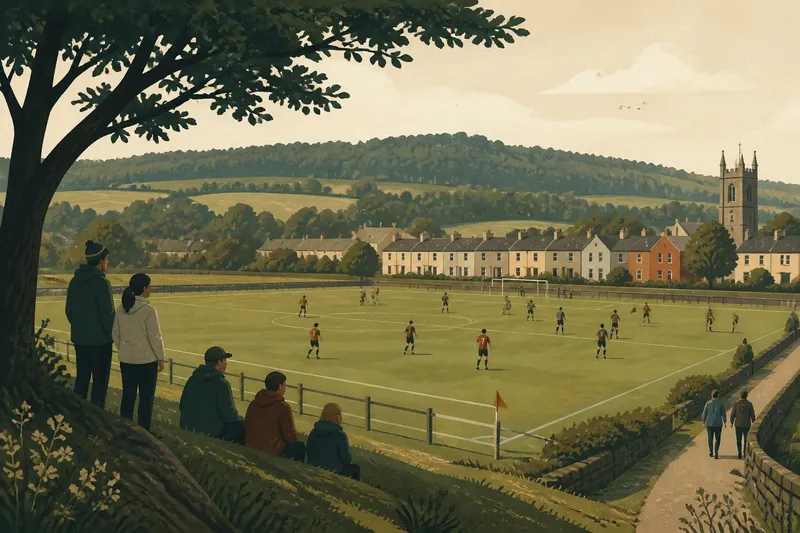
The common mistake is to treat every playing field as a flat rectangle with a few local details. That misses what makes a place recognizable—and can leave a visitor unsure where play ends, where spectators belong, or why a familiar game feels different here. The shape of a playing field changes the view because its edges, ground, and surroundings direct attention as much as the action does.
What shapes the view?
A field’s character often starts at its boundary. A painted line offers a clean, temporary edge; a low wall, hedge, fence, embankment, or change in turf can make the limit feel physical. In some places, the boundary is close to the playing area. Elsewhere, it sits beyond a broad strip of ground, leaving more room between players and onlookers.
Those edges affect how a spectator reads movement. A ball approaching a wall behaves differently from one rolling toward open grass. A fence can frame a play while interrupting the view; a low boundary may preserve a clear sightline but make the playing area feel close and exposed. The edge is not decoration. It is part of the visual grammar of the place.
Shape matters too. A long, narrow ground draws the eye along its length, while a compact or irregular space brings its far edges into view sooner. A curve or angled boundary can make the play seem to open toward one side. The field need not be symmetrical to feel coherent: its shape may answer the land it occupies, the sport it hosts, or the built surroundings around it.
Why does the boundary matter?
The boundary tells people how to interpret space. It helps players judge distance and spectators understand whether an object is still in play. It also separates the field from the ordinary routes, gardens, paths, and streets around it. When those divisions are clear, the place can feel legible without needing a grand entrance or a formal stand.
Different boundary materials give different impressions. A chalk or painted line is easy to see but visually light. Rope, netting, and fencing make separation more obvious, while a bank or retaining edge can turn the perimeter into a place to sit or watch. A hedge adds a soft, leafy frame; a stone wall makes the boundary feel settled into the landscape. These choices can alter the mood even when the playing area itself is unchanged.
Boundaries also shape the audience. A broad verge may allow people to gather without pressing against play. A close fence can concentrate attention on a narrow strip of action. A raised bank gives some viewers a higher angle and others a place to pause. A visitor should not assume that the most obvious edge is a permitted route or seating area; local signs and the behavior of event staff can clarify where spectators may stand.
How do slopes change play?
A slope changes the field’s profile and the way it appears from the side. Even a gentle rise can hide feet, a low ball, or activity on the far edge from someone watching at ground level. From higher ground, the same slope may reveal the whole surface and make the movement easier to follow. The view is therefore not a single fixed picture: it depends on where a person stands.
Uneven ground can also make movement look less predictable. A ball may slow, turn, or travel differently across a surface that is not uniform. Players adjust to what the ground gives them, while spectators may notice how the contest changes near a bank, dip, or sloping edge. The field’s contours become part of the local style of play, rather than a backdrop that disappears once the game begins.
For visitors, the practical effect is simple: a clear view from one spot does not mean every spot offers one. A fence post, tree, or rise can block a particular line of sight. Moving a short distance along the permitted spectator area may change the angle more than expected. Think of the field like a window: its frame determines what can be seen, and a small shift in position can bring a different part of the scene into view.
Which landmarks frame a field?
Landmarks help locate a playing place in memory. A church tower above the far touchline, a row of apartment blocks beyond a fence, a wooded ridge, or a harbor visible past an open end can make the field unmistakably local. These features give the eye a point beyond the game, setting the action within a larger landscape.
Not every landmark is distant or scenic. A clubhouse, water tank, railway embankment, school wall, or line of trees may provide the strongest reference. Its importance comes from its position: a structure behind a goal may frame attacks, while a tall building along the side can dominate the view whenever the play turns that way. Familiarity grows through these repeated alignments.
Say you arrive at an invented neighborhood ground where one end opens toward a wooded ridge and the other faces a row of low buildings. If you choose a permitted place beside the long boundary, the ridge may remain in view behind play moving toward that end; shifting around the perimeter can bring the buildings into the frame instead. The expected observable result is a different sense of the same contest: one angle emphasizes the surrounding landscape, the other the dense neighborhood. The field has not changed, but its relationship to the place becomes easier to notice.
Does a playing field need to be level?
No. A level surface may suit some sports and settings, but it is not a universal template for a meaningful playing place. Fields can follow the contours of available land, and their boundaries can adapt to trees, paths, buildings, or other existing features. What matters for a particular game is whether the playing area works for its rules and participants, not whether it resembles a standardized diagram.
That distinction is useful for spectators, too. An irregular outline does not automatically make a field confusing. Clear markings, recognizable edges, and a view of how the space meets its surroundings can make an unusual layout easy to read. Conversely, a neat rectangle can feel anonymous if there is little to distinguish its edges or connect it to the place around it.
When the sport has specific requirements, organizers and facility managers need to follow the relevant rules and venue guidance. A visitor can still appreciate the landscape without assuming that every visible slope or unusual boundary is suitable for every game.
Why do fields look local?
Fields look local because their shape records practical choices. A boundary may follow a road rather than a compass point; a slope may preserve the form of the ground; a stand or shelter may occupy the side with the clearest approach. These choices gather into a view that belongs to that particular place. The field is not merely placed in a landscape; its outline shows how people have made room for play there.
The next time you arrive at a ground, notice what contains the playing area, what rises or falls around it, and which landmark sits behind the action. Those details answer why the shape of a playing field changes the view: they give players a space to negotiate and give spectators a way to recognize where they are. A small shift along the edge may reveal the best view not of the score, but of the field’s connection to its surroundings.