A First Away Fixture, Planned Around the Journey
Plan a first away fixture around the journey, with time to arrive, get oriented and pause so travel feels calmer and the sporting day can unfold.
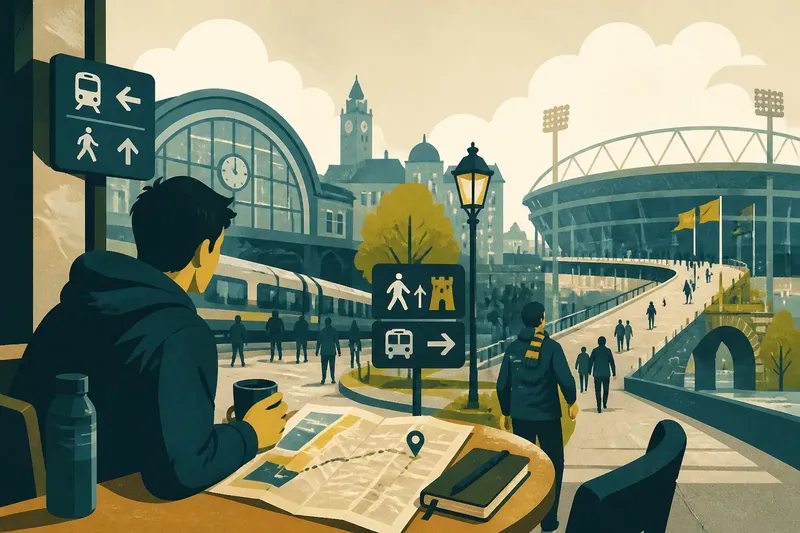
The most common mistake when planning a first away fixture is treating the trip as a straight line from home to the gate. That leaves little room for a delayed train, an unfamiliar station exit or the quiet moment needed to understand where you are. A better plan makes the journey part of the day: arrive with room to orient yourself, then choose how much structure suits your appetite for uncertainty.
Three travel rhythms
There is no single best way to reach a sporting place you have never visited. A tightly timed itinerary can make sense when connections are dependable and the venue is easy to reach. A flexible plan can feel better when local transport is unfamiliar. Staying nearby may suit a trip where the fixture is only one part of the experience.
Think of these as different rhythms, not grades of competence. The right choice depends on how many unfamiliar pieces you are joining together, what you want to do before the event, and how comfortable you are making decisions on the move.
The direct itinerary
This approach links a known route to the venue with a modest buffer. You might travel by train to a familiar city center, then use a clearly marked tram or a short walk. It suits travelers who enjoy a defined plan, have a straightforward connection, and would rather spend their attention on the event than on exploring.
Its advantage is simplicity: fewer decisions to make en route. Its weak point is that a small disruption can affect the whole sequence. Keep the plan direct without making it brittle. Know the next reasonable departure or route alternative, but avoid filling every pause with another scheduled stop.
The orientation-first itinerary
Here, arrival comes before the venue. You reach the area with time to notice the station layout, find a landmark, and work out how the last part of the trip feels on foot or by local transit. This approach suits a first visit to a sprawling city, a venue on the edge of town, or a traveler who relaxes once the surroundings make sense.
Orientation does not require a sightseeing circuit. A café near the station, a public square, or a clearly signed transit hub can serve as a calm anchor. You can then decide whether to continue toward the ground, sit for a while, or take another look at the route.
The nearby-base itinerary
For a longer journey, consider staying within a practical distance of the venue or the transport route that serves it. This gives the day more than one arrival point: you can settle in, take a break, and approach the fixture without carrying the entire trip on your shoulders. It suits travelers who want an unhurried day, are traveling with companions, or are combining the match with time in the area.
The trade-off is that accommodation adds another decision and may not be worthwhile for a simple day trip. A nearby base also does not automatically mean an easy route; check the connection you would actually use, rather than relying on a map’s visual closeness.
Choose your rhythm?
How much arrival time should I allow?
Allow enough time to recover from the journey, identify the route to the venue, and handle a likely pause without rushing. The right margin depends on the number of connections, the distance from the station, and how settled you feel in unfamiliar surroundings.
Should I go straight to the venue?
Go directly if the route is clear and you prefer a simple day. If the station or neighborhood is unfamiliar, a brief stop at a recognizable public place can make the next decision easier without turning the trip into a sightseeing tour.
Is a hotel near the ground always best?
Not necessarily. A place near a reliable transit line may be more useful than one that looks close but requires an awkward transfer or a long walk. Choose based on the route you expect to take and the kind of pause you want before or after the fixture.
What if the weather changes?
Keep one sheltered pause in mind, such as a station concourse or a public café, and check what you can carry comfortably. For outdoor fixtures, the event organizer’s guidance and local conditions should shape clothing and access decisions.
Build in arrival space
Arrival time is not wasted time. It is the part of the plan that lets you notice the difference between the route you imagined and the one in front of you. A station may have several exits; the nearest one on a map may not lead toward the venue. A bus stop can sit across a busy road rather than beside the station entrance.
Before leaving, identify the station or stop you need, the venue’s public entrance, and one recognizable point between them. Save the address and route details somewhere accessible without a strong signal. If the venue publishes an access map or travel advice, use that to understand entry points and any restrictions. For event access, transit changes and local requirements, follow the relevant organizer, transport operator or local authority instructions.
Then leave space between arrival and the moment you need to be at the gate. That interval can absorb a slow connection, a wrong turn or a pause to check directions. It also gives you a chance to notice how people move through the area, which can make the final approach feel less like decoding a puzzle.
Make pauses useful
An unhurried pause need not be elaborate. It can mean sitting somewhere warm, filling a water bottle where permitted, or checking the route while you are not standing in a crowd. The aim is to keep a small decision from becoming a rushed one.
Choose pauses that support the day rather than add errands. A café with clear signage near a transport hub may be more useful than a celebrated spot across town. A bench in a public square can offer a moment to look at the map and decide whether to continue on foot. Everyday objects make the point: a pause is like a bookmark, holding your place without making you reread the whole journey.
Imagine you arrive by train in an unfamiliar city and discover that the station has two exits. Instead of immediately following the largest crowd, you step into the concourse, check the saved venue map, and identify a nearby landmark shown on the route. You then take the exit that faces that landmark and pause at a café before continuing. The expected result is simple and observable: you know which direction to walk, have a place to regroup, and are less likely to spend the next stretch checking your phone at every corner.
Plan around uncertainty
Not every trip needs a backup plan for every possible snag. Focus on the parts that would be difficult to improvise: the last connection of the day, a route that depends on a single transfer, or a venue entrance that is not obvious from the street. For each, know one sensible alternative. That could be another transit route, a staffed information point, or a clear place to wait while you check updated service information.
Keep essential route information easy to reach, and avoid relying on a single source if your connection is complex. Transit apps can help, but station signs and operator updates may be more useful when service changes. If you are traveling with someone, agree on a simple meeting point in case you become separated, preferably a named public location rather than “near the entrance.”
For a fixture in a smaller town, the final leg may have fewer options than a city route. Check the return journey before setting out, especially if public transport runs less often later in the day. This is not a reason to make the whole trip tense; it is a way to protect the unhurried part of it.
Choose the right approach
Use the direct itinerary when the route is familiar, the connections are simple, and you want the day to stay compact. Choose orientation-first when the place itself is the main unknown and a calm first look will help you settle. Consider a nearby base when the journey is long or you want room around the fixture for rest and exploration.
If you are torn, look at the number of unfamiliar transitions rather than trying to predict every delay. One unfamiliar station may call for a little orientation time. Several transfers, a distant venue and a late return may make a nearby base worth considering. A straightforward route with a clear entrance may need no more than a comfortable buffer.
A first away fixture, planned around the journey, does not need a packed itinerary to feel considered. Choose a rhythm, leave room to arrive, and give yourself one dependable place to pause. Once you know where you are and how the next leg works, you can turn your attention to the sounds and movement of the sporting day itself.
Before you leave, save the venue’s exact address and the name of the stop you plan to use. That small detail can help you distinguish the right destination from a similarly named station or entrance, especially when the crowd begins moving in several directions.